
SPF - Spray Polyurethane Foam Roofing System
Energy-Efficient Protection for Homes and Businesses in the San Joaquin Valley.
Get a Free Quote
Success Stories From Those Who Know Us Best
EXCELLENT Based on 25 reviews
 Posted on Google
 Mary RaymondAs new property owners outside of the state, we had to fit in a new roof in a limited timeline. They managed to squeeze us in, and I couldn't be happier with the results. They also re-roofed the small accessory building that serves as an outdoor storage room. I chose the 'birchwood' color for tiles, despite the house being white, and it looks awesome! Also, a big plus for me was Donovan's prompt communication - very responsive and on top of things. I felt that the cost was very reasonable. I very highly recommend them.Posted on Google
 Matt OrpinCalled with a question and Don picked up immediately and was very friendly and understanding. Would suggest ⭐⭐⭐⭐⭐Posted on Google
 Raphael JardimVery responsive and knowledgeable professionals. I highly recommend it.Posted on Google
 Paulo AcobaWe had a handful of leaks after that excessive rainfall and Donovan and his crew worked with our schedule to get them fixed ASAP. Specialty Roofing was reliable, did a quality job, were knowledgeable, and delivered the work with A1 customer service. Don't hesitate giving them a call!Posted on Google
 Jon StarkeyWe had a couple challenges, however Donavon took care of them without issue, I highly recommendPosted on Google
 Sandra HayThey came right out to so an inspection and provide an estimate. Work was done quickly and everything was cleaned up afterwards. Very responsive to questions with quick conversation replies.Posted on Google
 Chris BruynzeelAmazing company! So pleased with the work they did on our roof a couple months ago. Fast, respectful, courteous, excellent work. Can’t recommend them highly enough.Posted on Google
 Dave JohnsonThese guys are pros pros,definitely a 10/10 definitely recommend-billPosted on Google
 albert madkinsSpecialty roofing was great. Work with me and my insurance company I had multiple problems that I needed to have taken care of and Donovan . So if you're looking for a good honest reliable roofing company specialty roofing is it!Posted on Google
 Melodi BuschAppreciated the time spent on roof as well as the problem with my gutters.
Summers in the San Joaquin Valley regularly push past 100 degrees, and roofs here take the brunt of it. Spray polyurethane foam roofing creates a seamless, fully adhered layer over your existing roof that stops leaks, adds insulation value, and reflects heat away from the building. That combination makes it one of the more practical options for flat and low-slope roofs across Fresno, Modesto, Merced, and the surrounding communities.
We install spray foam because it solves problems other systems struggle with. Because the foam is applied as a liquid and expands in place, it conforms to penetrations, parapets, and odd transitions without seams or fasteners — the exact spots where conventional roofs tend to fail. It can also be applied over most existing roof surfaces, which often means no tear-off and less disruption to your operations or household.
For over 35 years, Specialty Roofing of CA has worked on commercial and residential buildings throughout the Valley, and foam has become a core part of what we do. Below, we cover how the system works, what it costs to maintain, how long it lasts, and when it makes sense compared to other roofing options.
How Spray Foam Systems Protect Low-Slope Roofs
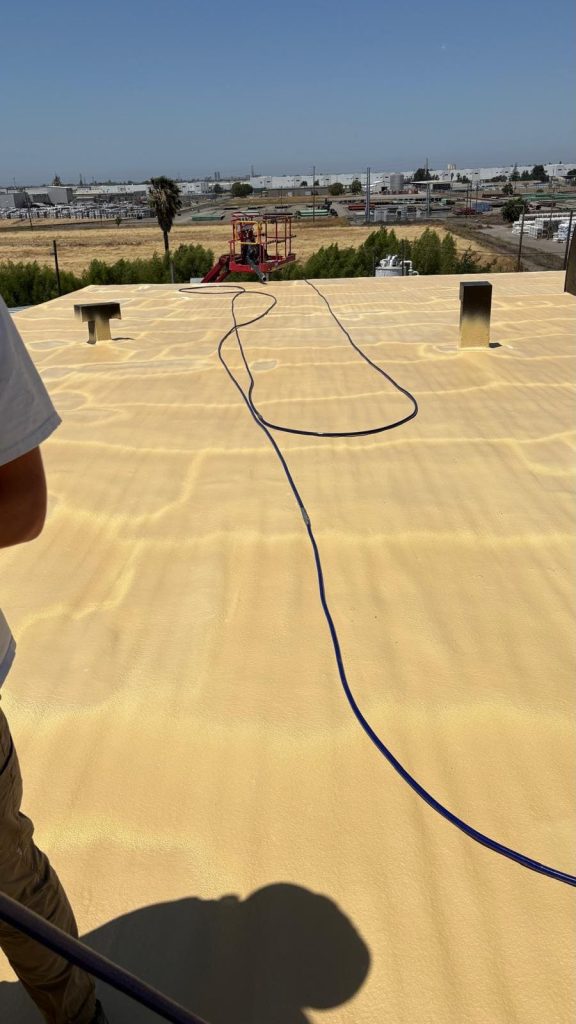
Spray polyurethane foam bonds directly to the existing deck as a monolithic layer, sealing the penetrations and seams where flat roofs in the San Joaquin Valley typically fail. The same application delivers closed-cell insulation and a reflective coating surface, and it can be installed over most substrates already in place.
Seamless Waterproofing And Leak Prevention
SPF is sprayed as a liquid and expands in place, so there are no laps, fasteners, or field seams to open up later. That matters on low-slope roofs, where water sits rather than runs off.
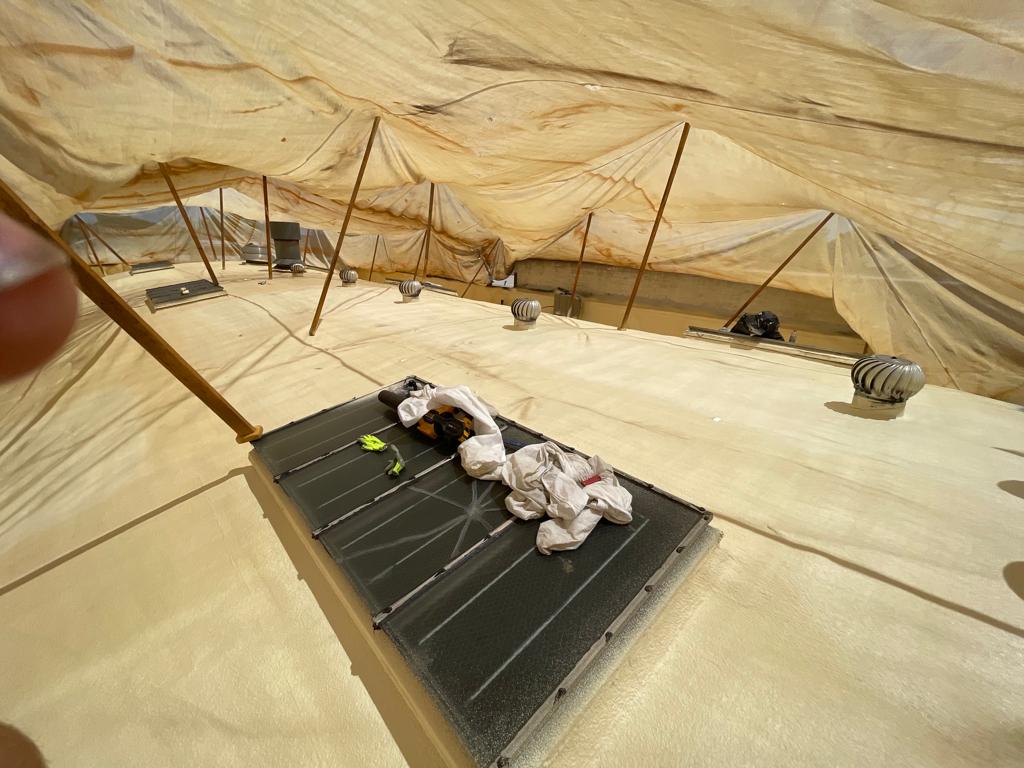
We build the foam to encapsulate parapet walls, curbs, drains, pipe penetrations, and HVAC stands — the details that account for most leak calls on flat roofs.
Foam can also be tapered to correct ponding. By sloping additional thickness toward drains and scuppers, we redirect standing water instead of leaving it to sit against the membrane.
A protective elastomeric topcoat shields the foam from UV exposure, which is the primary cause of foam degradation. Recoating on schedule — generally every 10 to 15 years — restores that layer and extends service life well past the original installation.
Insulation Performance And Energy Efficiency
Closed-cell SPF used in roofing typically provides about R-6 to R-7 per inch, so a 1.5-inch application adds roughly R-9 to R-10 to the assembly. That insulation sits above the deck, reducing thermal bridging through joists and framing.
The foam also seals air movement through the deck. In valley summers with attic and plenum temperatures well over 120°F, that reduction in air infiltration affects cooling load as much as R-value alone.
The white or light-gray coating reflects a significant share of solar radiation, lowering surface temperatures compared with dark built-up or modified bitumen roofs. Combined, the insulation and reflectivity reduce heat gain and can lessen mechanical run time during Fresno, Bakersfield, and Modesto cooling seasons.
Roof Deck Compatibility And Surface Preparation
SPF adheres to a wide range of low-slope substrates, which is why recover work is often possible without a full tear-off:
| Substrate | Typical Preparation |
|---|---|
| Metal | Fasten loose panels, prime rusted areas |
| Built-up / tar and gravel | Remove loose gravel, spud surface |
| Concrete | Clean, dry, prime as needed |
| Plywood / OSB | Verify sound decking, replace soft sheets |
| ISO board / cap sheet | Confirm attachment, dry out wet sections |
| TPO / EPDM | Clean, abrade or use adhesive primer |
Before spraying, we test for moisture in the existing assembly. Wet insulation must be cut out and replaced — foam applied over trapped water will not bond properly and the moisture stays in the roof.
The surface has to be dry, clean, and above minimum application temperature, with wind conditions low enough to control overspray. We schedule accordingly, since valley morning dew and afternoon wind both affect application quality.
Planning A Durable Roofing Investment
A spray foam roof performs only as well as the substrate beneath it and the coating layer above it. Both factors, along with correct application in Valley conditions, determine whether the system lasts 10 years or 30.
Assessing Existing Roof Conditions
Before we quote an SPF installation, we core-sample the existing assembly to check for saturated insulation. Wet substrate must be removed, since foam applied over trapped moisture will blister and delaminate.
We also document:
- Deck type and condition — metal, concrete, wood, or existing single-ply membrane
- Moisture content — verified by infrared scan or core cuts
- Ponding areas — low spots where water sits longer than 48 hours
- Penetrations — HVAC curbs, drains, vents, and skylights that need detail work
- Structural load capacity — SPF adds roughly 0.5 lbs per square foot at 1.5 inches
One advantage worth noting: SPF can often be applied directly over a sound existing roof, avoiding tear-off costs and landfill disposal fees. That only works when the substrate is dry, well-adhered, and structurally sound.
Coating Options And Maintenance Requirements
Polyurethane foam degrades under UV exposure, so the topcoat is not optional — it is the component that determines service life.
| Coating Type | Typical Mil Thickness | Recoat Interval | Best Suited For |
|---|---|---|---|
| Acrylic | 20–30 mils | 10–15 years | Sun-exposed Valley roofs, budget-conscious projects |
| Silicone | 20–25 mils | 15–20 years | Roofs with ponding water |
| Polyurea | 20–40 mils | 15–20 years | High-traffic areas, mechanical rooms |
Granules are usually broadcast into the base coat where foot traffic is expected.
Maintenance is straightforward but not optional. We recommend inspections twice a year — spring and fall — plus after hailstorms. Small punctures from dropped tools or bird damage are sealed with caulk or patch coating, and a full recoat at the scheduled interval resets the system’s clock.
Professional Installation For San Joaquin Valley Properties
Foam application depends heavily on weather. We schedule spraying when the substrate is above 50°F, wind speed stays under 15 mph, and humidity is within the manufacturer’s range — conditions that limit the workable window during Valley winters and windy spring afternoons.
Overspray control matters in agricultural and industrial areas. We use wind barriers and monitor conditions continuously to protect vehicles, equipment, and neighboring structures.
Our crews are trained on the specific foam and coating systems we install, and we follow manufacturer specifications on pass thickness, typically applying foam in 1/2 to 1-1/2 inch lifts rather than a single heavy pass. That approach produces consistent density and better adhesion.
We provide written documentation of foam thickness, coating mil readings, and warranty registration at project close.
Specialty Roofing Free Quote Request
Please provide us with your contact information, and some details about your project. We can then provide your free quote. There is no obligation, and we do not believe in high-pressure sales tactics. We will NOT sell or rent the information you provide.
If this is an emergency, please call (209) 777-0875
Step-by-Step to Achieving Your Roofing Goals
At Specialty Roofing of CA in San Joaquin Valley, CA, we make the roofing process simple, efficient, and stress-free.
Free Consultation & Inspection
A thorough assessment of your roof and space to determine the ideal skylight placement and installation solution.
Personalized Estimate
A clear, tailored estimate based on your skylight selection, roof requirements, and installation needs.
Convenient Scheduling
Flexible scheduling that makes it easy to plan your skylight installation around your availability.
Expert Installation
Professional skylight installation focused on proper placement, secure fitting, and reliable roof protection.
Final Inspection & Cleanup
A careful inspection of the completed installation followed by a thorough cleanup, leaving your space bright, clean, and ready to enjoy.
Areas We Serve
Frequently Asked Question
Property owners across Fresno, Bakersfield, Visalia, Modesto, and Stockton ask us the same core questions about spray polyurethane foam: what it costs, how long it holds up, whether it meets code, and how it handles Central Valley summers. The answers below cover installation over existing roofs, expected service life with recoating, and real performance under sustained heat.
What are the benefits of a spray foam roof for residential and commercial properties?
Spray polyurethane foam is applied as a liquid that expands into a seamless, fully adhered layer. There are no seams, laps, or fasteners, which removes the most common leak points on flat and low-slope roofs.
The foam also functions as insulation. Closed-cell SPF delivers roughly R-6 to R-7 per inch, so a typical 1.5-inch application adds about R-9 to R-10.5 to your roof assembly.
Other practical advantages include:
- Self-flashing around curbs, drains, HVAC units, and skylights
- Lightweight at about 0.5 lbs per square foot, adding minimal structural load
- Slope correction — foam can be tapered to eliminate ponding water
- Spot repairability — damage is patched without replacing large sections
For commercial owners, the reduced cooling load matters most. For homeowners with flat or low-slope sections, the seamless waterproofing and ability to build positive drainage tend to be the deciding factors.
How long does a spray foam roofing system typically last?
The foam itself does not degrade under normal conditions. What wears is the protective elastomeric topcoat, which shields the foam from UV exposure.
A properly installed SPF roof with an acrylic or silicone coating generally performs for 15 to 20 years before recoating is needed. Recoating involves cleaning the surface and applying a fresh layer of coating — no tear-off, no disposal fees.
Because the substrate stays intact, the service life extends with each recoat cycle. Many SPF roofs in California have remained in service for 30 years or more through routine recoating.
Manufacturer warranties commonly run 10, 15, or 20 years depending on coating thickness and system specification.
How much does spray foam roofing cost in the San Joaquin Valley?
Installed costs generally fall between $4.50 and $9.00 per square foot. The range reflects foam thickness, coating type, roof complexity, and the condition of the existing substrate.
Several factors push the number up or down:
| Factor | Effect on Cost |
|---|---|
| Foam thickness (1″ vs. 3″) | Higher thickness increases material cost |
| Silicone vs. acrylic topcoat | Silicone costs more, handles ponding better |
| Number of penetrations | More curbs and pipes means more labor |
| Existing roof condition | Wet insulation requires removal first |
| Tear-off avoided | Saves $1.00–$2.00 per square foot |
We provide a written per-square-foot figure after a roof inspection that includes a moisture survey. That inspection determines whether the existing assembly can stay in place, which is usually the largest single variable in the price.
Is spray foam roofing permitted under California building codes?
Yes. SPF roofing systems are approved under the California Building Code and Title 24 energy standards when installed with a compliant reflective topcoat.
Title 24 requires low-slope commercial roofs in most Valley climate zones to meet minimum aging solar reflectance and thermal emittance values. White acrylic and silicone coatings used over SPF typically carry CRRC-rated aging reflectance around 0.70 to 0.80, which satisfies cool roof requirements.
Fire classification also matters. SPF assemblies achieve Class A ratings when specified with the correct coating thickness and, where required, a granule surfacing.
We pull permits and document CRRC product data for Title 24 compliance as part of every commercial installation.
Can spray foam roofing be installed over an existing roof?
In most cases, yes. SPF adheres to built-up roofing, modified bitumen, metal, concrete, and wood decking, which is why it is used so often for restoration rather than replacement.
The condition of the existing roof determines whether an overlay is appropriate. We perform an infrared or core-sample moisture survey first — saturated insulation must be cut out and replaced, since foam applied over trapped moisture will blister and fail.
Loose gravel, ballast, and failed coatings also require removal. Single-ply membranes such as TPO and EPDM generally need to come off, because foam does not bond reliably to them.
When an overlay is viable, you avoid tear-off labor, landfill fees, and the disruption of an open roof deck.
How does spray foam roofing perform in extreme heat and sun exposure?
The San Joaquin Valley regularly sees stretches of 100°F-plus days, with roof surface temperatures on dark membranes climbing well past 150°F. A white-coated SPF roof reflects the majority of incoming solar radiation, keeping surface temperatures substantially lower.
The insulation value works alongside the reflectivity. Reducing heat transfer through the deck lowers cooling loads and eases strain on rooftop HVAC equipment during July and August.
Thermal movement is handled well by the monolithic assembly. Because there are no seams or fasteners, the daily expansion and contraction that opens laps on other systems has no weak point to exploit.
UV protection depends entirely on maintaining the topcoat. We recommend annual inspections to catch coating thinning or mechanical damage before exposed foam begins to oxidize.